NeuGuitars Man
( english version )
Andrea Aguzzi was born in Milan in 1969, he lives and works in
Mestre near Venice. He has a degree in Business Administration from
the Ca 'Foscari University of Venice and has always been passionate
about the internet, music and guitar.
He is the blogger of the NEUGUITARS Blog, dedicated to
avant-garde, experimental and contemporary music for guitar.
https://neuguitars.com/. He was also co-founder of the AlchEmistica
netlabel dedicated to classical and contemporary music with a
Creative Commons license.
In addition, he has published four very interesting books:
“Netlabels. Musica, Economia,
Diritto, Società in Internet” (2012). (in italian)
“Chitarre visionarie. Conversazioni
con chitarristi alternativi”, (2014). (in italian)
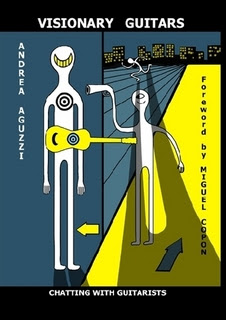
Visionary Guitars. Chatting with
Guitarists (2016), only in English.
Amazon.it:
Visionary Guitars Chatting with Guitarists - Aguzzi, Andrea - Libri
Il recente “John Zorn The Book Of
Heads” (2020), only in English.
John
Zorn The Book Of Heads: Amazon.it: Aguzzi, Andrea: Libri
On his blog NeuGutars he publishes
numerous articles on very often underestimated or too demanding
topics, according to the points of view and commercial needs. In
reality, Aguzzi's competence and passion make these topics very
versatile and easy to understand. Certainly to listen to some of his
proposals you need to have an open mind and a well-trained ear to
listening, but nothing impossible.
From his proposals it's clear that over
the years he has acquired a very effective method of analysis and
understanding, with a strong focus on aspects such as composition,
improvisation, interpretation and technological development of
instruments.
Andrea has created a formula of 10
questions for his interviews, but I'm a little more curious and maybe
I'll do at least a dozen, let's see what he answers:
How was your passion for music and
classical guitar born?
About thirty years ago I decided to
learn to play an instrument and bought a classical guitar. I didn't
really want to play classical music, but more pop stuff. However,
given my lack of talent, I decided to go to class with a teacher,
luck would have it that I found Mrs. Liliana Amato, wife of Maestro
Angelo Amato, who at the time was teaching classical guitar at the
Venice Conservatory. She not only taught me what I wanted, but she
also introduced me to the world of classical guitar and Brazilian
music. I owe her a lot, she was a great teacher. I studied with her
for 3 years, a beautiful formative period.
Do you play an instrument?
I play, intermittently. I still have my
old classical guitar, a Yamaha CG 120 and two electric guitars: a
1996 Fender Stratocaster Mexico and a restored 1980's Eko Les Paul
model. Two beautiful instruments, dear memories of a friend who is no
longer with us. I also have a headless electric guitar, a Chinese
kit, which I had turned into a fretless guitar. It has a sound of its
own.
Have you studied composition?
No. I have a high school diploma and a
degree in Business Administration in Venice. Never attended the
Conservatory. For the rest I am self-taught, I listen, I read, I
study, I am interested.
When did you start to suffer from the
limitations of "mass market" offerings?
I don't really suffer from it and have
never suffered from it. The first record, which I bought when I was
11, was The Police's single "Every little thing she does is
magic" and I still have it along with all their albums that I
continue to listen to with pleasure. I have never really suffered the
distinction between underground and mainstream, I listen to what
interests me, even if maybe I don't like it. I've never sided in
favor of one genre over another, although there are things I don't
listen to just like Italian melodic song and opera, for example. My
musical training is definitely rock and from there I started to
expand: jazz, classical, ethnic music, experimental, noise. More than
the genre itself, I am interested in listening and understanding how
musicians love to mix the cards on the table. I like prototypes,
things on the edge of borders, even if they are unlistenable. I have
nothing against trap and rap. I refuse to think that today good music
is no longer produced, even in the "mass market". Those who
say it remind me of the two old gentlemen from the Muppett Show.
Today many beautiful records are produced, like 10, like 20 years
ago. Except that we already have a selection of the past and it is
easier to find your way around. Today the offer is huge. For the
listener it is certainly not a bad thing. Has society changed? What's
the news?

How important is it that there are
creative composers who know how to break the mold?
I don't know if and how important it
is, I'm glad they are there. I agree with what Scott Johnson writes
in his essay "The Counterpoint of the Species": life
changes, evolves in non-linear ways by adapting and anticipating the
needs that the environment, nature and the desire for survival
impose. For an artist these factors are given by the culture, the
environment, society, the economic and technological situation that
surround him and with which he interacts. Then each one makes his own
choices, that are necessarily personal. There are those who feel the
desire, the need to go against society, those to follow it, others to
flatter it. Each choice corresponds to the results and to an audience
that follows them. In addition to creative composers, there must be
creative interpreters and improvisers and an audience interested in
their proposals. We are not very far, even in this case, from a form
of market segmentation.
What fascinates you more than composition: the methods for its drafting or the final result? a
A bit of both, but my musical training
is based more on listening to music rather than reading a score. So I
would tell you that the final result is what I aim for right away,
then I try to deepen, to understand what lies beneath and here things
get complicated, because the score is not enough for me. I want to
understand the logic behind not only the compositional choices but
also the interpretative ones, so I read, write and listen to again.
Interpreters must be highly motivated
to be able to survive with a repertoire that is still so undervalued,
what could be done to facilitate them?
I'm afraid I don't understand the
question. What do you mean by "facilitating them"?
Facilitate them to choose that repertoire or support them from an
economic point of view? In the first case, I really don't know what
to answer: it depends on them, I have never dared to suggest a
particular piece to an interpreter. It's up to the interpreter to
find and perform what interests her/him most, what she/he finds best
suited to her/him sensitivity. I think it's up to them to find the
artistic, economic, cultural and social motivations to do this job.
As for the economic aspect, I always think that the best way is to
buy their records and go to their concerts. Unfortunately at the
moment the second thing is still impossible due to Covid-19. But
we'll be back.
What quality do you appreciate most in
an interpreter?
Expressiveness. This is regardless of
the genre she/he plays and the type of music she/he makes.
Expressiveness is the first thing, then come tine, phrasing, ideas,
capacity for innovation. But expressiveness always remains in first
place, it does not change if it comes from Allan Holdsworth, Eric
Clapton, Julian Bream, Elena Casoli, Jimmy Page ...
You
have published four books on interesting topics, I think each of them
required a lot of effort, what was it like to enter the world of
publishing?
I
really don't think I got into it, in the sense that I chose to
produce the books myself, thus doing translations, editing and
corrections myself. I learned a little by little and I am still
continuing to learn. I have never proposed anything to a publishing
house and therefore I don't know that economic and cultural context.
I write only for the pleasure of doing it, not to follow an economic
activity: I earn practically nothing from my books, they are on sale
at cost price. Same thing for the blog, not surprisingly there are no
advertising banners. My profession is another and I must say that I
like my job and that I will continue to do so. I don't want to be a
professional blogger.
Despite the idea, of many bigots, that
blogs are uninteresting and unprofessional, you passionately manage a
blog that is always updated with articles and information that is
difficult to find elsewhere. How do you manage to acquire so much
information for your "little blog" ... have you created a
network of contacts with the various players in the sector?
I listen, I read, I study. Simply
because I like to do it and try to do it as best I can. It's a
question of attitude. When I approach a musician, perhaps on a social
network, I show him/her that I know his/her music, that I buy his
/her records, perhaps from himself/herself, on his/her Bandcamp
platform. If I interview him/her I avoid banal and closed questions,
I try to write reviews that explain what is inside that record and
that provide as many cultural coordinates and connections as
possible, because my goal is not the artist reading the review, but
the music lover who reads my blog and who wants to know, maybe, if
it's worth spending 20 euros for that cd or LP. From this point of
view I don't consider myself a critic, but a music lover. I don't
like to cut off a record or an artist. This is not in my education: I
am not able to perform even 5% of what the musicians I follow can do,
so I do not allow myself to enter into technical executive issues,
which among other things would be of little interest to my audience
and followers. . I also avoid entering the territories of taste, my
personal taste. A music, an album has every right/duty to be listened
to regardless of whether I like it or not. I hate controversy, I keep
away from it as much as possible, even when I am offended, blocked or
provoked on social media, because this also happened. And then I
publish almost everything in English now. This choice allowed me to
broaden my horizons in an incredible way. Currently Neuguitars.com
makes an average of about 7,000 visits per month, only 15% come from
Italy, the rest is the world, the United States and Germany first.
Every day I receive an average of ten between emails, whatsup and
messages that suggest me, offer plays, videos and records. Nothing,
then, makes me more happy than reading emails and messages from
musicians who report other musicians and records to me. I get 15-20
CDs and LPs per month. I do not hide my collecting and archival
vocation. Yes, I think I managed to create my own network of contacts
that grows every day. And it makes me happy, because I have the
opportunity to listen to crazy things and meet incredible people,
outside my daily horizon. I believe this is the strength and
potential that is hidden behind a blog. For the rest, the same thing
always applies: in every environment there are some excellent things
and others that you can gladly do without, it's true for blogs, for
music, for work, for television, etc ... the important thing it's
choosing well, looking for content, quality. There are fantastic
blogs that should be read: I follow Guitar Moderne, The Quietus, The
Rest Is Noise by Alex Ross, The Free Jazz Collective, a Jazz Noise,
Percorsi Musicali, Tone Glow, Pitchfork, which host high-level
content and are very transversal. There are excellent blogs for all
tastes, for lovers of cooking, books, architecture… why not
discover them? There is so much to learn. Then there is another
aspect: a blog is a personal world and as such I live mine. Among the
ones I mentioned there are professional blogs, with an editorial
staff and multiple people writing. For my blog I do everything
myself. Sometimes I receive emails, all from Italy, with the words
"Dear Director ...", "Dear Editor ...", they make
me smile a little. I try to do things in the best possible way, but I
am neither professional nor professional. I think this is the big
catch: often those who misjudge blogs expect, for free, the same
professional, graphic, editorial level of a newspaper or magazine,
which they are rightly paid for. For me, it doesn't work like that:
my blog was born as a personal story, as an outlet for a passion,
therefore necessarily unprofessional. It's useless to expect
something that, for its DNA, is not there. There are certainly blogs
that are well done, well cared for and a problem can arise here: some
amateur, specialist blogs have higher content than many newspapers
and magazines. But this is not a problem of the blog, but of the
professional publishing sector. I am silent on political blogs.
That's a world I can't form an opinion on.
Why did you decide to publish your
latest book, dedicated to John Zorn, only in English?
I write practically everything in
English by now. Even the previous book made in 2016, “Visionary
Guitars. Chatting with guitarists ”was in English and is not a
translation of the Italian “Chitarre Visionarie” released in
2012. It will be more and more like this, I am not very interested in
publishing books in Italian and the reasons are different. As for the
blog, I can reach a wider and more interesting audience, even without
resorting to the bookstore circuit. In Italy people don't read books
so much. It's useless to waste energy for a limited audience. Better
to focus on a wider and more passionate audience who, in the case of
my Italian reader, often also reads texts in English too. I also
avoid a sea of controversy and insults. If those who, in the
past, wrote, blamed, insulted me for what they said they read in my
Italian books, had bought and read them for real, by now I would be a
millionaire in bit coins. My English books have been criticized, even
severely, but I've never been offended or blocked on Facebook for it.
If I publish in English I cut out a large portion of the public that
I gladly do without. Same reason why I left, with rare and precise
exceptions, the Facebook's groups of Italian music and guitar
enthusiasts. For example, about the book "John Zorn The Book Of
Heads" I received several messages and emails asking me where to
find the Italian version. So far, so good. The problem is that often,
after replying that there no Italian version, I was asked to send the
proofs of the book in Italian, because “otherwise how can I do
without… how can I understand if the book sucks…? " We are
at these levels. I take this opportunity to answer another nagging
question: there are no scores of The Book Of Heads in the book, I
don't distribute them, I don't sell them, nor do I give them as a
gift. If you want them you have to buy them from John Zorn himself.
I promised twelve questions, so this is
the last one, what do you think of the economic situation in which
the world of the Arts has plunged?
Here, too, I am afraid that I have not
understood the question: what are you referring to precisely? To the
art market? To the situation of artists in general? The market does
not seem to me to suffer from a crisis, while many artists are not
doing well at all. The crisis triggered by Covid-19 has certainly
accentuated the difficulties given that it has reduced the
possibilities of social encounter and art thrives on sociality,
exchanges, encounters, which in turn feed a market made up of art
exhibitions, concerts, masterclasses. In this context, music is not
already doing very well, due to the social changes that have pushed
more and more for a vision in which music is not just a commodity but
a gratis thing, not free, gratis. Music streaming, which is perfectly
legal, has resulted in a significant loss in musicians' income. I was
reading recently that only about 12,700 artists manage to exceed the
figure of 50,000 dollars in annual revenues on Spotify and that it
takes about 120-130 plays of a song to generate a profit of 1 cent. 1
cent! Many of the musicians I follow have abandoned Spotify in favor
of a more profitable platform like Bandcamp, where the primary
purpose is not streaming but the direct sale of CDs and LPs and where
the earnings are higher. For many of them, concerts and teaching are
the real sources of income. For teaching, often private or in
priority schools, the obligation of the absence of attendance has
meant a reduction in lessons and the absence of concerts not only
reduces earnings, but also the possibility of directly selling one's
records and creating new contacts for new concerts, masterclasses,
collaborations, etc. The income crisis due to layoffs and job losses
will also lead to a reduction in consumption. Many people will think
twice when choosing between cultural goods and goods of primary
necessity. The art market is different: our economies have been
flooded by a sea of liquidity that seeks new alternative
investment opportunities to the financial, banking and insurance
markets. Hence the boom in the electronic currency market, see Bit
Coin and auction houses. Try to look at how much the classic car
market has grown, for example. The art market is no exception.
Cultural assets, especially tangible ones, are often seen as an
interesting form of alternative investment, with a different
allocation of savings assets. That sector, like that of luxury, knows
no crisis. Furthermore, this crisis has highlighted how little
consideration artists enjoy at the political and social level: I have
not seen any country shining for aid in the cultural, artistic and
entertainment sectors. Already the neoliberal political wave of the
last 25 years had made a clean sweep not only of welfare, but also of
many subsidies in the cultural sectors, I fear that this crisis will
complete the work. Furthermore, the world of art has never shone for
efficiency and transparency in economic management. Most of its
institutions are cut off from the market and live more from public
and private subsidies than from the sale of tickets or merchandising,
how many orchestras have disappeared in the last twenty years because
they were no longer able to cope with operating costs. ? We need new
managerial figures, new curators, a new vision at the system level.
Other than that my eyesight fails to go. There is so much, perhaps
too much, to do and to renew and there is a big lack of skills.